

Insomnia: impacts on the body and health
Written on December 3, 2025, by Pauline de Santarome
In France, 1 in 5 people suffer from chronic sleep disorders. This alarming figure continues to rise in our modern society, where stress and screens are omnipresent. Insomnia directly affects physical health, concentration, alertness, and the ability to manage stress. Prolonged sleep disorders can lead to chronic fatigue, physical pain, a weakened immune system, and an increased risk of metabolic or cardiovascular disease.
Understanding the mechanisms of insomnia and adopting appropriate strategies is essential for improving sleep quality and protecting overall health. To support your nights, you can find all the Santarome sleep supplements from Santarome.

Understanding insomnia and its mechanisms
Insomnia is not just a simple difficulty falling asleep. It is a complex disorder that can take many different forms and whose consequences go far beyond simple morning fatigue.

Definition and types of insomnia
Insomnia is characterized by difficulty falling asleep, frequent nighttime awakenings, or non-restorative sleep. There are several types of insomnia:
Temporary insomnia: lasts less than 3 weeks and affects around 30% of the population each year. It is usually linked to a trigger such as a one-off stressful event, travel, or a traumatic event.
Chronic insomnia: persisting for more than three nights per week for several months. It is often associated with a primary or secondary sleep disorder.
Difficulty falling asleep: difficulty falling asleep in less than 30 minutes, despite feeling tired.
Frequent nighttime awakenings: interruptions in deep slow-wave sleep and REM sleep, disrupting recovery.
What really distinguishes insomnia from simply having a bad night's sleep is its impact on the following day: persistent fatigue, difficulty concentrating, irritability... Quality of life is truly affected.
Common causes of insomnia
The causes of insomnia are numerous and often interconnected. Understanding what is disrupting your sleep is the first step toward getting a good night's rest.
Stress increasescortisol production and prevents you from falling asleep. Sometimes, it is also anxiety related to sleep itself that causes problems. Do you know that feeling? The more you try to fall asleep, the more elusive sleep becomes.
Irregular lifestyle, night work, exposure to blue light from screens before bedtime.
Diet: excessive caffeine intake, heavy or late meals.
Hormonal disorders, sleep apnea, restless legs syndrome, or chronic diseases that disrupt the natural sleep cycle.

Why sleep is vital for health
Sleep is a period of intense activity for our bodies. An adult needs 3 to 5 sleep cycles of 90 minutes each to fully benefit from its restorative effects.
During deep slow-wave sleep, muscles relax, tissues repair themselves, and the immune system is strengthened. REM sleep, on the other hand, consolidates memory, regulates mood, and supports brain function. Chronic sleep deprivation (less than 6 hours per night over a prolonged period) does not simply create a sleep debt—it profoundly disrupts overall physiological balance and leads to fatigue, decreased alertness, mood disorders, and daytime sleepiness.

The consequences of insomnia on physical health
The effects of insomnia go far beyond simple fatigue. This disorder profoundly affects several vital systems in our body.
Chronic fatigue and reduced performance: insufficient sleep leads to constant fatigue, lack of concentration, and impaired alertness. Everyday tasks require more effort, and sleep quality directly influences energy levels and recovery. Daytime sleepiness and difficulty falling asleep can disrupt professional and social life.
Cardiovascular disorders and blood pressure: Lack of sleep increases the risk of high blood pressure and cardiovascular disease. Short or fragmented nights lead to prolonged activation of the sympathetic nervous system, stimulating blood pressure and heart rate.
Weakened immune system: Do you often get sick after periods of poor sleep? This is no coincidence. Insomnia and the immune system are closely related. The immune system regenerates mainly during deep slow-wave sleep. Non-restorative sleep reduces the production of immune cells and antibodies, making the body more vulnerable to infections and delaying healing.
Metabolic problems and weight gain: "I slept poorly, I'm hungrier than usual." This feeling is not psychological but physiological. Lack of sleep disrupts the hormones that regulate appetite, leptin and ghrelin, promoting hunger, weight gain, and fat storage. Chronic insomnia increases the risk of type 2 diabetes, obesity, and other metabolic disorders.
Muscle and joint pain: Insufficient sleep limits muscle and joint recovery. Tension builds up, causing physical pain and stiffness. Restorative sleep is necessary to relax muscles and relieve pain.
If your symptoms persist, it is recommended that you consult a healthcare professional to identify the cause and prevent complications.
Insomnia and Hormonal Balance
Our bodies function thanks to a finely tuned orchestra of hormones. Insomnia profoundly disrupts this harmony.
Impact on melatonin and circadian rhythm
Melatonin, nicknamed the "sleep hormone," is produced by the pineal gland in response to darkness. It plays a crucial role in regulating our internal biological clock.
It regulates sleep and the day/night cycle. Insomnia disrupts its production, disrupts the biological clock, and reduces the duration of restorative sleep, affecting physical and mental health.
These disturbances also desynchronize all peripheral circadian rhythms: liver, adipose tissue, muscle, etc. The result is a loss of coordination between the body's various systems.
Cortisol and stress disruption
Cortisol, often referred to as the "stress hormone," normally follows a precise circadian rhythm: high in the morning to help us wake up, then gradually decreasing until evening.
It increases when sleep is insufficient. High cortisol production at night prevents sleep and increases irritability and anxiety.
Effects on leptin and ghrelin production (hunger and satiety)
Have you ever noticed that you eat differently after a sleepless night? That's because insomnia profoundly disrupts the hormones that regulate your appetite.
Leptin, which signals satiety, and ghrelin, which stimulates hunger, become unbalanced when sleep is lacking. This promotes overeating and weight gain.
These changes persist even after sleep recovery, which explains why metabolic disorders can become permanent after periods of chronic insomnia.

How can you promote restful sleep naturally?
Faced with these worrying consequences, the good news is that there are effective natural solutions to improve the quality of your sleep.
Sleep hygiene: routines and environment
Sleep hygiene encompasses all practices that promote natural sleep onset and quality sleep:
Establish a regular bedtime routine to signal to the body that it is time to sleep (reading, gentle stretching, deep breathing).
Adapt the sleeping environment: quiet, cool, and dark room, good bedding.
Limit screen time and blue light exposure two hours before bedtime and avoid stimulating activities.
Respect a sleep duration that is appropriate for each adult's sleep needs.
It is important to be patient—improvements in sleep hygiene produce gradual effects, usually after 1 to 3 weeks of consistent practice.
Food and plants for better sleep
Certain plants and nutrients promote sleep. In the evening, choose foods rich in tryptophan (bananas, chicken, dairy products), sources of magnesium (almonds, nuts, green vegetables), and carbohydrates (brown rice, sweet potatoes).
Several plants, such as chamomile, valerian, lemon balm, and passionflower, have been shown to be effective in improving sleep quality. Herbal tea can calm the nervous system, promote relaxation, and make it easier to fall asleep.
Timing is also important: eat a light dinner 2-3 hours before bedtime, and if you feel hungry before going to sleep, opt for a light snack rich in tryptophan (yogurt, banana).
Relaxation techniques: reducing anxiety and stress
Stress is the number one enemy of sleep. Learning to relax before bedtime is essential for getting a good night's sleep.
Meditation, deep breathing, and gentle stretching before bedtime. You can opt for cardiac coherence (breathing in and out for 5 seconds for 5 minutes), progressive muscle relaxation (contracting and relaxing each area of the body for 5 seconds), or mindfulness meditation using apps such as Calm or Petit Bambou.
Journaling or gratitude exercises to calm the mind.
Visualization techniques to promote deep sleep and REM sleep.
With regular practice, these techniques become increasingly effective in calming the mind and preparing the body for sleep.
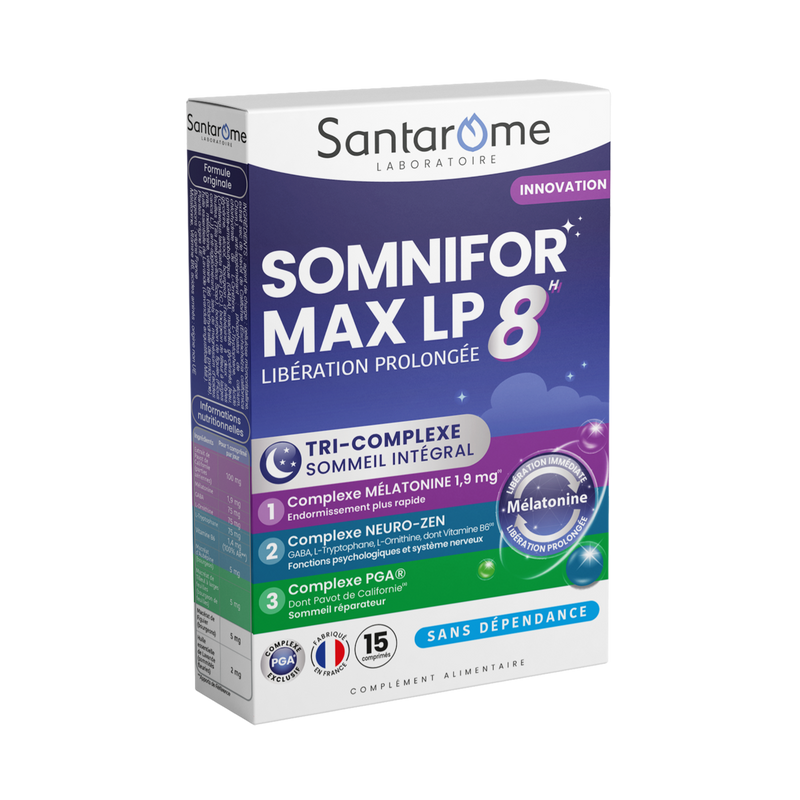
SOMNIFOR MAX LP 8H by Santarome: an ally against severe sleep disorders
When natural measures are no longer enough, targeted support may be needed to restore quality sleep. SOMNIFOR MAX LP 8H tablets tablets are a direct response to severe sleep disorders. This dietary supplement is particularly suitable for people who:
Have significant difficulty falling asleep
Wake up frequently during the night
Feel tired despite a night's sleep
Suffer from non-restorative sleep
The strength of SOMNIFOR MAX LP 8H lies in its unique formulation, which combines three complementary complexes:
Dual-release melatonin complex: works for 8 hours for continuous sleep.
Neuro-Zen Complex: GABA, L-tryptophan, L-ornithine, and vitamin B6 to calm stress and promote sleep.
PGA Complex: California poppy, trio of buds, and lavender essential oil for a relaxing and natural effect.
Unlike traditional sleeping pills, which can be addictive and impair sleep quality, SOMNIFOR MAX LP 8H respects natural sleep cycles and targets the various causes of insomnia.
Remember that sleep is not a luxury but a biological necessity. Taking care of your nights is investing in your long-term health. So tonight, turn off your screens, create a relaxing atmosphere, and give your body the rest it needs to stay in top shape. Your physical health will thank you!

★★★★★ - Chloe
SOMNIFOR MAX LP 8H
"Since I started taking this supplement, my sleep has been much more regular.I fall asleep more easily and stay asleep without waking up in the middle of the night."